Ideas move fast; calendars don’t. Stakeholders still want answers by Friday, but the earliest interview slot is… next Thursday. That’s why AI chatbots are winning for customer feedback and product concepts, for smart follow-ups, and for the research data you can use this week.
If you’re a startup founder or product lead, you know the pain: one or two calls a week, time-zone ping-pong, pricey agencies, and survey forms that miss the “why.” Here we’ll show how AI chat interviewers fix those spots, then compare the best options so you can pick what fits your team’s needs.
Why AI Interviews Beat Surveys and Calls
AI-led interview “chatbots” collect more detailed open-ended answers than standard web surveys, while also assisting with live coding and follow-ups. It’s evidence that conversational formats can boost data quality, speed, and more.
Fewer no-shows, less scheduling
Live calls are hard to line up across time zones and calendars, so you end up with one or two interviews a week and slow learning cycles.
Better “why,” not just scores
Static questionnaires capture ratings, not reasons. Without clarifying follow-ups, you miss causes, examples, and edge cases that actually drive decisions.
Results fast enough for the sprint
By the time notes are cleaned up, the sprint is over. Teams need research data tomorrow, not next month.
Proof you can show stakeholders
Stakeholders want proof. If a quote isn’t linked to a timestamped recording or transcript, approvals slow down.
Global audiences, multiple languages
If you don’t reach people in their language or usual channel, fewer respond, and you hear from whoever’s easiest, not who matters most.
Best AI Chatbots: Quick Comparison by Use Case
Here’s a one-glance summary to put up front. Details of each tool come right after.
| Platform | Best when | Strengths | What to trade off | Pricing note* |
| Frank | No-shows/time-zones are killing you; you need sprint-speed insights and evidence packs from voice interviews (WhatsApp and video coming soon) | Always-on AI interviews; instant/overnight summaries; transcripts/highlights; 30+ languages; trained on 650k+ interactions | If you also want recruiting + incentives + consider an ops-bundled suite (see Strella) | Starter $59/mo |
| Listen Labs | You need multilingual scale and a strong enterprise/security posture | 50+ languages; SOC 2 Type II; results in hours; large panel options | Chat-native WhatsApp isn’t the emphasis | Free trial available |
| Strella | You want the whole research-ops loop handled | Built-in recruitment, incentives, and scheduling; AI-moderated interviews; real-time synthesis | Language breadth less foregrounded | Starter $150/mo on annual |
| Qualz.ai | Budget-light pilots and voice-first collection | AI-moderated interviews + voice surveys; transparent tiers | Not an ops suite | £1,100 per project |
| HeyMarvin | You want governance & sharing with an optional AI interviewer | Research repo with AI synthesis | Not primarily chat-native | Free → $50/user/mo |
Below, each pick includes how it shines, where it’s weaker, and the “if you care more about ___, try ___ instead” nudge.
1. Frank
Frank is an always-on AI customer interviewer that conducts deep, science-driven conversations with your real customers and delivers structured insights overnight — the kind of work that usually needs a big research team and six-figure budget. Trained on 650k+ customer interactions, Frank supports 30+ languages and can run 100+ interviews simultaneously.
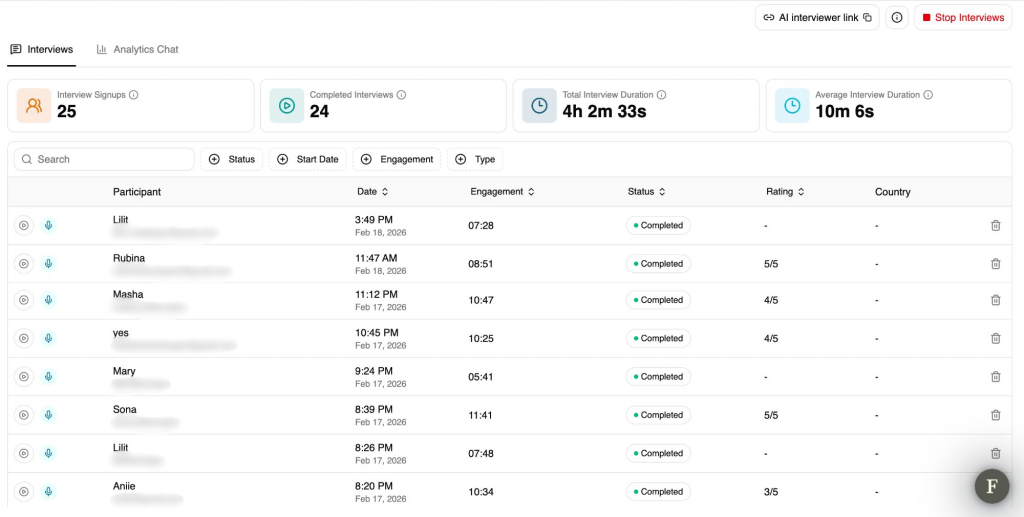
Currently Frank conducts interviews via voice, with video and WhatsApp coming soon.
Pricing: Free trial available. Starter $59/mo on annual.
Pros
- Always-on voice interviews — no scheduling, no no-shows, no time-zone juggling
- Overnight summaries with themes and quotes so insights arrive in time for the sprint
- Smart follow-ups that probe deeper than static surveys to uncover the real why
- Recordings, transcripts, and logs to build stakeholder trust and speed sign-off
- Runs 100+ interviews simultaneously — no more 1–2 calls per week
- Five-minute guided setup so PMs, Marketing, and CX can run it without a research team
- 30+ languages with real-time translation for global coverage
- Video and WhatsApp coming soon for even more flexibility
Cons
- Built-in recruiting/incentives/scheduling not the focus
- Requires an existing customer base to interview
Trade-offs (try these if that’s your priority)
- Need ops handled end-to-end → Strella
- Need a central research repo with governance → HeyMarvin
- Want a budget-light pilot → Qualz.ai
2. Listen Labs
Listen Labs is an AI qualitative research platform that runs thousands of one-on-one, open-ended interviews in parallel, then auto-analyzes and packages the results (customer feedback summaries, transcripts, video highlights, auto-generated decks).
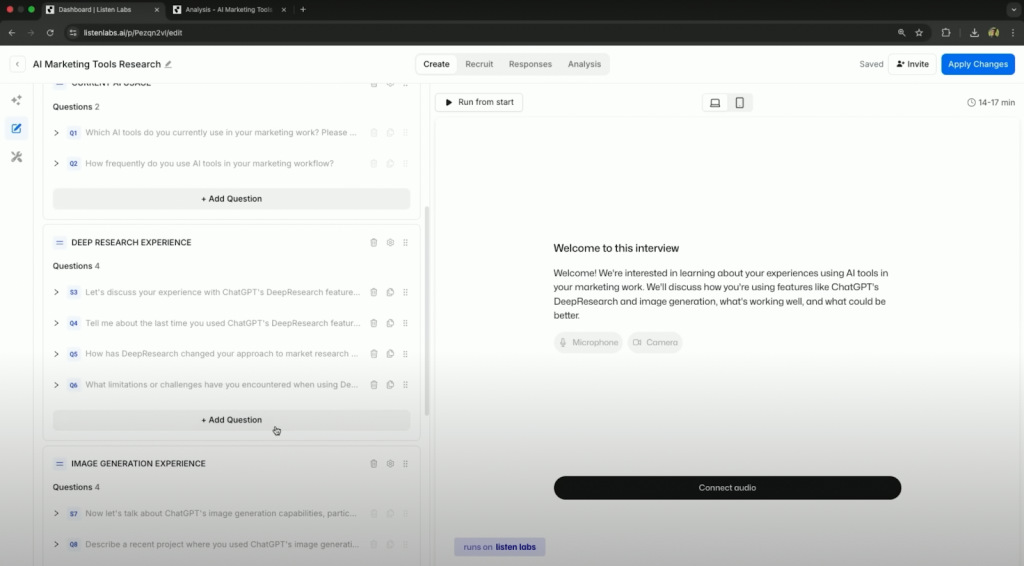
Pricing: Free trial available; you can also join the waitlist to get discount alerts.
Pros
- Runs many 1:1 AI interviews in parallel, fixing “too few interviews/too slow”
- Adaptive follow-ups uncover the “why,” deeper than surveys
- Auto-analysis with themes, quotes, highlight reels, and exec decks for faster handoff
- Works for concept/creative tests, brand/persona work, and prototype checks
- Can reduce reliance on agencies and big research teams
Cons
- Not centered on WhatsApp/chat-native capture
- Recruiting/incentives/scheduling aren’t core
- Not a repo-first posture
Trade-offs
- Want always-on voice interviews to cut no-shows → Frank
- Want ops bundled (recruit + incentives + scheduling) → Strella
- Want a governance-first repository → HeyMarvin
- Want Free/PAYG to trial → Qualz.ai
3. Strella
Strella is an end-to-end AI qual platform that manages the whole research loop. You set goals, Strella’s AI drafts an expert interview guide, handles recruiting/scheduling/incentives, moderates interviews with dynamic follow-ups (or lets humans moderate), analyzes feedback in real time, and saves everything in a searchable research repository with reports.
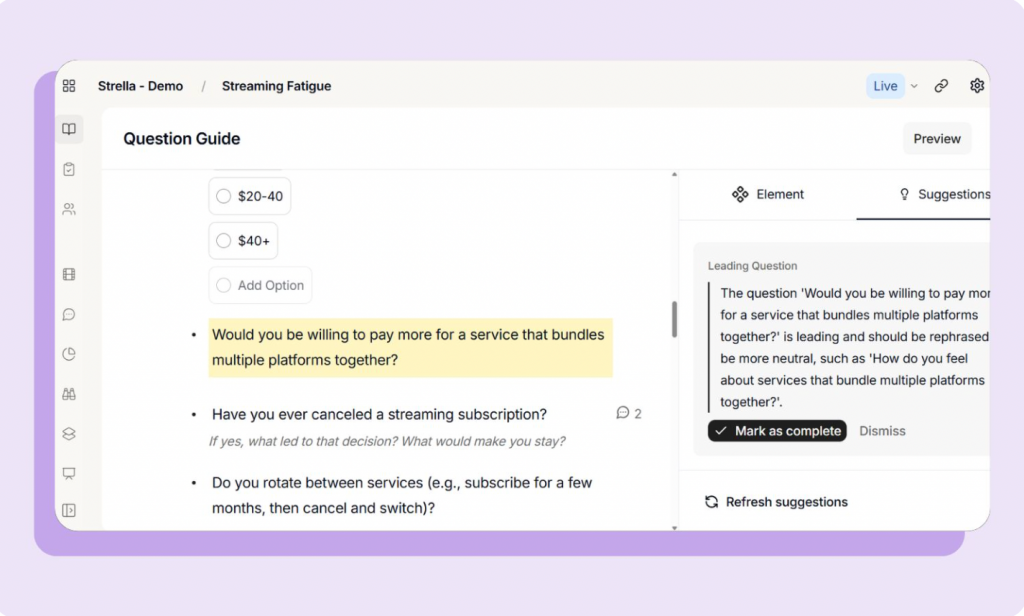
Pricing: Starter $150/mo (billed annually).
Pros
- End-to-end workflow (guide, recruiting, scheduling, incentives) that fixes “no time/team to schedule”
- AI-moderated interviews with dynamic follow-ups for depth beyond surveys
- Real-time analysis and reports for faster handoff, so insights don’t arrive too late
- Scales to many sessions in parallel, solving “only 1–2 interviews/week”
- AI market research repository that helps with “no clear owner” and stakeholder alignment
- Automation lowers effort versus agencies, addressing “agencies are too expensive”
Cons
- Language breadth isn’t pitched as 30+
- WhatsApp/chat-native interviewing isn’t the centerpiece
- Numbers/tiers not public
Trade-offs
- Need 30+ languages + full transcript transparency → Frank
- Need voice interviews today, video and WhatsApp coming soon → Frank
- Need budget-first → Qualz.ai
- Already have a repo and want a hub → HeyMarvin
4. Qualz.ai
Qualz.ai is an AI-first qual platform built by PhD researchers/AI engineers to speed up and lower the cost of qualitative work. It offers AI-moderated interviews, dynamic voice surveys, optional synthetic participants to accelerate early learning, automated transcription/coding/thematic analysis with visuals, default/custom reporting, and a “chat with your analysis” feature to query findings directly.
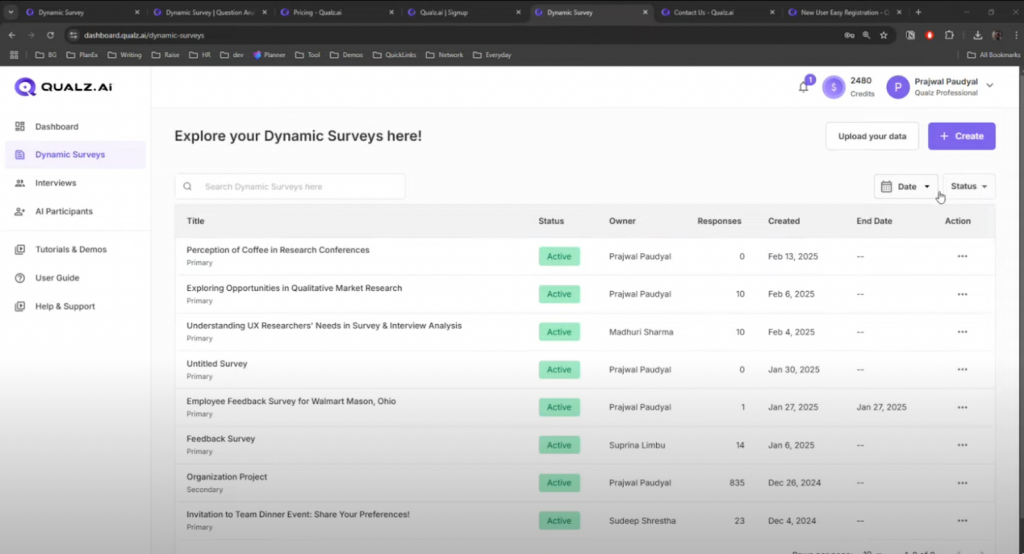
Pricing: PAYG/Free entry; paid tiers via pricing page/sales; Enterprise adds SOC2/HIPAA/SSO/Data residency.
Pros
- AI-moderated interviews plus dynamic voice surveys reduce scheduling overhead
- Automated transcription, coding, and themes speed analysis (claims up to 90%)
- Reports, visuals, and “chat with your analysis” make stakeholder buy-in easier
- Scales capture; optional synthetic participants help early exploration
- Lowers reliance on agencies for coding and reporting
Cons
- Not an ops suite (recruiting/incentives aren’t core)
- Video/WhatsApp emphasis is lighter
- Public language breadth not clearly quantified
Trade-offs
- Want ops handled end-to-end → Strella
- Want always-on voice interviews to reduce no-shows → Frank
- Need enterprise multilingual + trust posture → Listen Labs
- Want a repository hub as the anchor → HeyMarvin
5. HeyMarvin
HeyMarvin centralizes qualitative market research and customer feedback (interviews, surveys, support tickets) in one SOC 2–certified repository. Its AI assistant synthesizes documents/audio/video, surfaces themes, enables powerful search, and integrates with workflow tools like Slack.
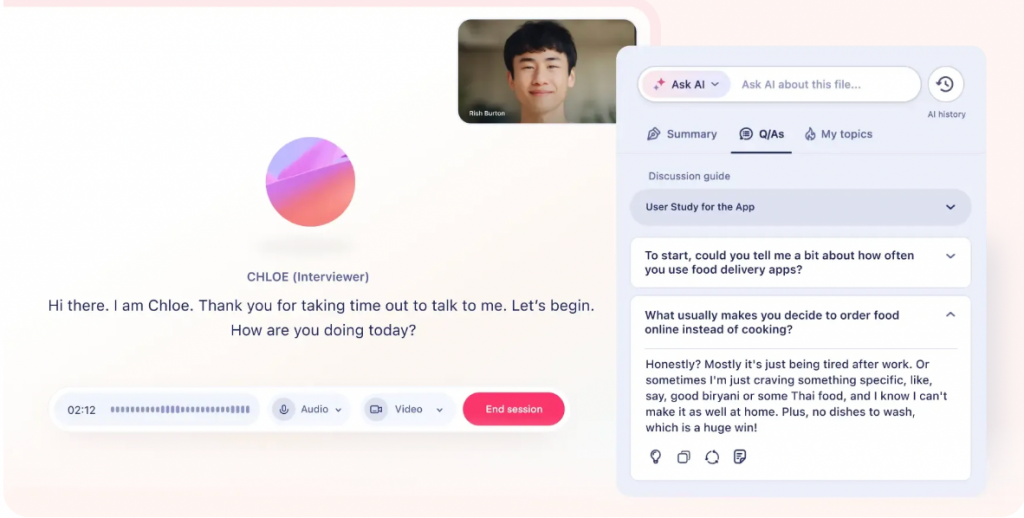
Pricing: Free (2 users) → Essentials $50/user/mo (5-user min, billed annually).
Pros
- Central repo plus AI synthesis enables faster handoff and fewer duplicate tools
- Pulls from many sources (interviews, surveys, tickets), which helps solve “no clear owner”
- Powerful search answers stakeholder questions quickly
- Slack and other integrations for sharing; SOC 2 for security
Cons
- Not primarily chat-native WhatsApp
- Recruiting/incentives/scheduling not bundled
- Interviewer limits vary by plan
Trade-offs
- Cut no-shows/time-zones via always-on voice interviews → Frank
- Need ops bundle in-product → Strella
- Need a trust portal → Listen Labs
- Want Free/PAYG starting point → Qualz.ai
Conclusion
AI chat interviews are a practical way to move from “we think” to “we know” on product questions. Each tool in this guide helps with part of the job; your choice should follow your pains: scheduling, depth, speed, evidence, or validation.
If you want a single flow that addresses all of those and stays friendly to lean teams, Frank is a strong pick. Start small, review the overnight insights pack with your stakeholders, and ship one meaningful improvement each cycle.